The home of architecture and design in the Asia-Pacific
Get the latest design news direct to your inbox!

Get the latest design news direct to your inbox!
The unique design of the Australian Garden in Cranbourne takes out international award.
September 22nd, 2009
The Australian Garden – the latest addition the the Royal Botanic Garden in Cranbourne, Victoria – was awarded the International Federation of Landscape Architects Design Excellence award at the Asia Pacific Region Congress earlier this month.
Taylor Cullity Lethlean (TCL) with Paul Thompson have taken the idea of curated gardens out of the realm of European structure and given it back to the Australian natural landscape.
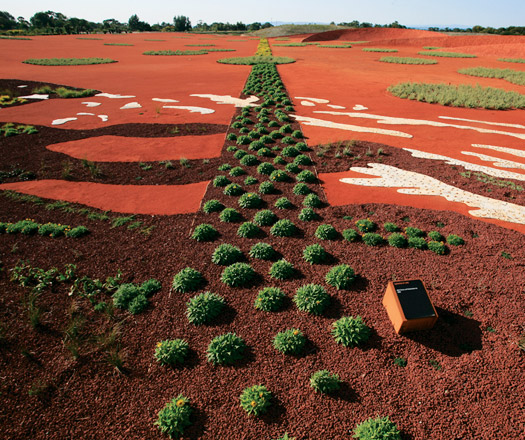
Using a range of sculptural and artistic landscape elements and incoporating those most iconic, vivid Australian colours, red earth, deep greens and blue sky (on a clear day of course), the designers have created an educational and rich experience for visitors.
An exploration of Australians’ relationship with their surroundings, The Australian Garden could only have worked on this large scale.
“The garden expresses this tension between Australians’ reverence and sense of awe for the natural landscape, and their innate impulse to change it, to make it into a humanly contrived form, beautiful yet their own work,” TCL explain.
The garden consists of several zones, from ‘abstracted woodlands’ and sand gardens on the western side to more structured highly designed gardens on the eastern side.
A large waterway divides these two personalities, ‘mediating’ between the natural and human derived elements. A large sculptural wall of red rusted steel interlocking blocks (like a rugged escarpment) designed by Greg Clrake, runs along the side of the creek.
Juxtaposing this water element is the large dry ‘red centre’ of the Sand Garden, created to resemble the Australian interior, with its low-clipped vegetation and rolling dunes of red sand.
The Australian Garden aims to show visitors the benefits and natural beauty of Australian landscapes and flora. Taylor Cullity Lethlean and Paul Thompson are now working on Stage two of the gardens, due for completion in 2011.
Hero image: View from the visitors centre of the sand garden. Photo by Peter Hyatt

Aerial photograph of The Australian Garden Stage 1. Photo by Peter Hyatt
Image Credits (Below):
2 – 3. Dianna Snape
4 – 5. Peter Hyatt
6 – 9. Ben Wrigley
INDESIGN is on instagram
Follow @indesignlive
A searchable and comprehensive guide for specifying leading products and their suppliers
Keep up to date with the latest and greatest from our industry BFF's!
Sydney architectural practice, NBRS+PARTNERS has created a design solution for the challenges of shifting demographic pressures with a response to balancing work and life in a highly urbanised environment. Impressively, this design solution is achieved in a 40-storey tower in the heart of Manhattan, New York.
The Queensland branch of the Design Institute of Australia (DIA) has announced it will once again be holding breakfast seminars throughout 2010. This year five seminars in total will take place – 4 in Brisbane and 1 on the Gold Coast, each featuring guest speakers selected for their varied points of view and experience. The […]
The internet never sleeps! Here's the stuff you might have missed