The home of architecture and design in the Asia-Pacific
Get the latest design news direct to your inbox!

Get the latest design news direct to your inbox!
The new Sustainable Singapore Gallery tells the story of Singapore’s environmental transformation through a multilayered and interactive walk-through narrative.

Zone A: Red Dot
September 28th, 2018
Zarch Collaboratives was commissioned by the Public Utilities Board (PUB) to design the new Sustainable Singapore Gallery located at the Marina Barrage. Refreshing and broadening the scope of a previous exhibition (which Zarch had also designed in 2008), the new showcase tells a multifaceted story of Singapore’s environmental transformation from conditions of scarcity and vulnerability to greater self-sufficiency and sustainability.
The role of Zarch Collaboratives as the lead architect and exhibition designer of the gallery involved working with the PUB on the content direction of the gallery and materialising its narrative, which is centred on Singapore’s water story and the interlinked strategies relating to the country’s parks, nature ways, buildings, infrastructure, and waste management systems.
On top of documenting Singapore’s environmental transformation, the exhibition also seeks to increase awareness of present and future environmental challenges and to promote a sustainable lifestyle. The narrative is presented through a combination of text, multimedia content, graphics, models, and interactive exhibits created in collaboration with multimedia consultant Ong Kian Peng, graphics consultant Tan Wee Lee and lighting consultant SWITCH.
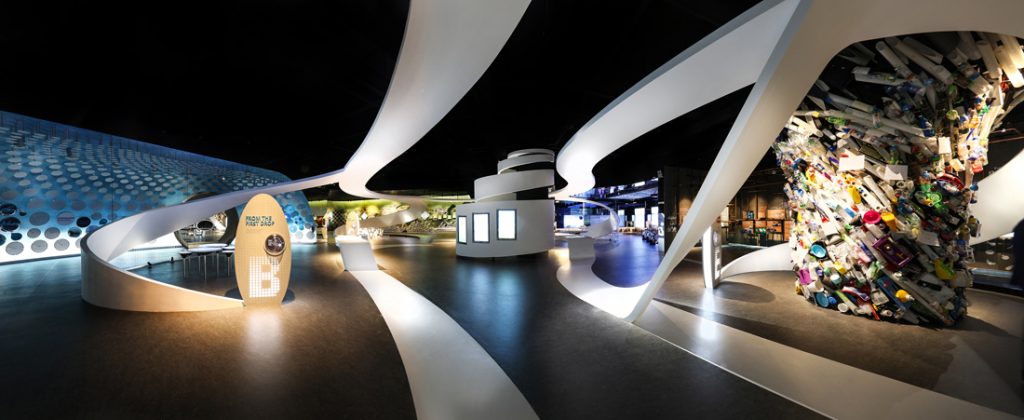
Overview of the gallery
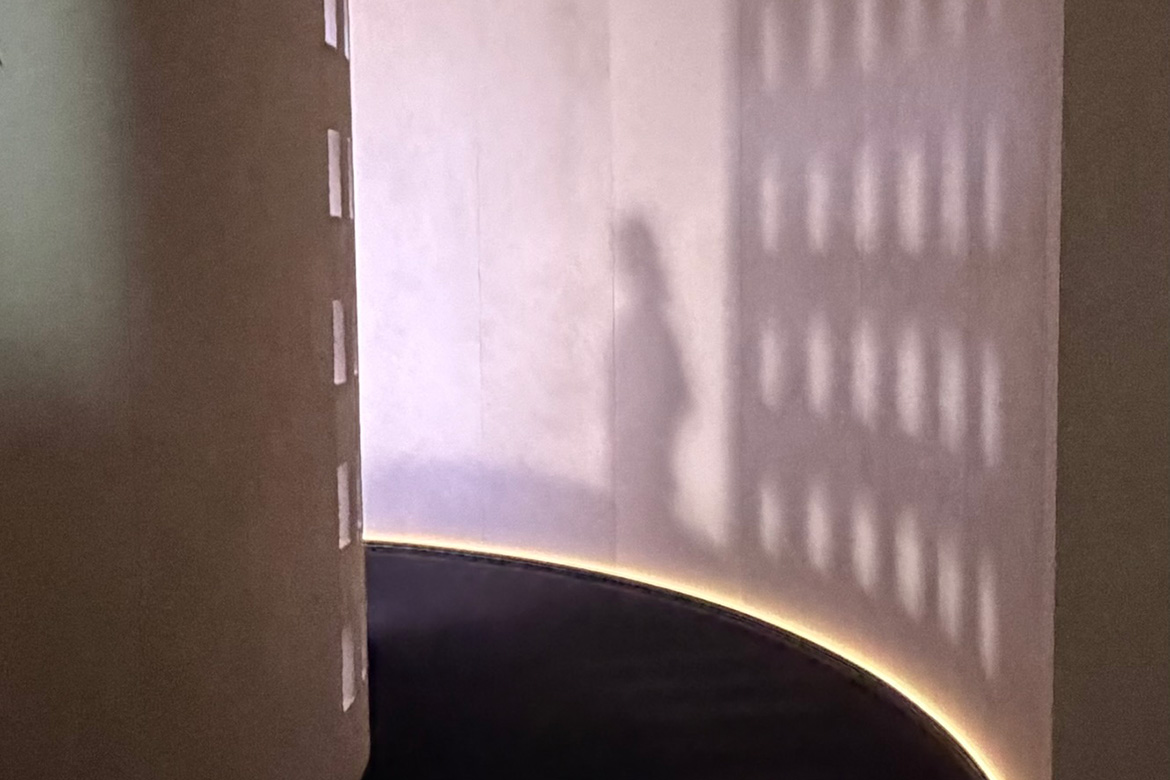
The visitor experience is immersive and interactive. Visitors arrive at the foyer and progress through a series of expanding chambers. The first focuses on climate change and provides a background context onto which the Singapore story then unfolds in subsequent spaces. A suspended grid of LEDs, programmed as a ‘screensaver’ to display the sky and weather conditions, canopies overhead and provides an ambient experience.
The main exhibition space is a large single-volume gallery that is anchored architecturally by a meandering ribbon structure that weaves through the gallery space. This ribbon spine guides visitors as they walk through the exhibits. It also references the shape and flow of the Singapore River. Suspended from above, the ribbon descends at various locations into vertical elements such as balustrades. Where the ribbon interfaces with the floor, it rises into a table-like element that functions as an exhibition display surface.
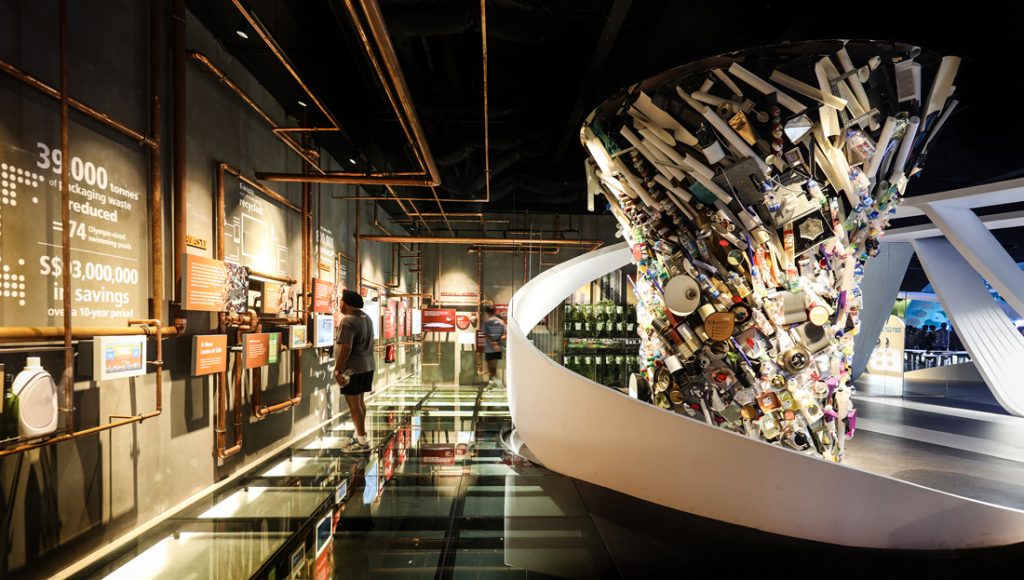
Zone E: Journey To Zero
Various everyday objects and elements such as PVC water pipes, copper conduits and recyclable waste are incorporated as part of the design to amplify the exhibition’s messages. There are many interactive elements, such as touch-screen tables that are an interpretation of Singapore’s Four National Taps (water from local catchments, imported water, NEWater and desalinated water) and stationary bicycles that allow visitors to pedal through an on-screen car-lite town.
Overall, the Sustainable Singapore Gallery is multi-layered experience that conveys the multifaceted narrative about Singapore’s environment and issues of sustainability surrounding it. The many interactive features, as well as the rich multimedia content and ambient experience, make the Sustainable Singapore Gallery memorable and relatable, and therefore a good piece of public engagement.
Photography: Zarch Collaboratives
INDESIGN is on instagram
Follow @indesignlive
A searchable and comprehensive guide for specifying leading products and their suppliers
Keep up to date with the latest and greatest from our industry BFF's!
The internet never sleeps! Here's the stuff you might have missed