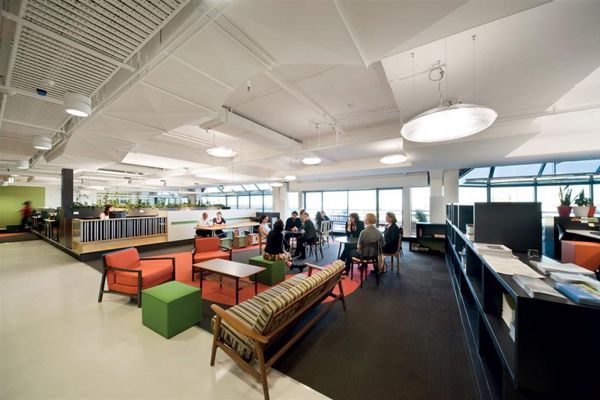
The Green Building Council of Australia has praised the Government’s new Commercial Building Disclosure program for mid-tier buildings.
February 19th, 2016
The program was originally developed to drive improvements in energy efficiency within the commercial office sector, and has found $44 million of benefits realised in its four year history.
“The review demonstrates why tackling energy efficiency in commercial office buildings is a smart solution to climate change – one that can be done at a minimal cost to industry and the tax payer,” says the Green Building Council of Australia’s Chief Executive Officer, Romilly Madew.
“The GBCA has always been a strong supporter of the CBD program, which has proven to be a critical driver in unlocking the emissions reduction potential of our buildings while raising awareness of building energy performance among building occupants, delivering cost savings and creating jobs.”
A new review of the program has identified two enhancements that could be made; a lowering of the threshold for mandatory disclosure of energy efficiency information on mid-tier buildings, and an extension of the length of time an office lighting assessment is valid from one to five years.
“Lowering the threshold for mandatory disclosure is particularly important, as it will open opportunities for greater energy efficiency in the mid-tier commercial buildings sector,” Ms Madew says, “There are an estimated 80,000 mid-tier commercial office buildings around Australia, but this sector has traditionally lagged behind in energy efficiency upgrades.”
With buildings being responsible for some quarter of Australia’s total greenhouse gas emissions, any improvements are a great idea for all.
Green Building Council of Australia
gbca.org.au
INDESIGN is on instagram
Follow @indesignlive
A searchable and comprehensive guide for specifying leading products and their suppliers
Keep up to date with the latest and greatest from our industry BFF's!
In the second instalment of our performance seating three-parter, we turn to DKO’s Michael Drescher and Jacob Olsen to peek behind Sayl’s confident architectural form and explore the ideas of inclusivity, adaptability and freedom to move as hallmarks of what sitting your best actually means.
In the first instalment of our three-part series exploring what it means to sit your best, we pose the question to Gray Puksand’s Dale O’Brien, who discusses the importance of ease and majority rule when it comes to sitting and reveals why specifying a task chair is not unlike choosing a Volvo.
In the last instalment of our three-part performance seating series, Alex Bain from Architectus explains why sitting well shouldn’t feel like sitting at all and explores an unexpected success metric of the hybrid workplace: the grounding power of emotional support.
Stepping into Intuit’s Sydney workplace certainly doesn’t feel like walking into an office. Why? In this film, we discover that, when joy takes precedence as a design driver, even a high-performing commercial CBD headquarters can feel like an intuitive wonderland that invites employees to choose their own adventure.
In this comment piece, Indigenous Creative Lead at Balarinji, Johnny Bridges, discusses designing with Country and the environment.
Registration for Brisbane in Design closes today (Wednesday 27 August). Click here to register now!
The internet never sleeps! Here's the stuff you might have missed
After Milan Design Week’s ‘festival of consumption’, 3daysofdesign offers a much-needed reset, an opportunity to ‘make the world a better place’ and perhaps even a soft-launch of the future.
In this edition of The Edit, we take a closer look at Pedrali’s presence at the 64th Salone del Mobile.Milano, from the exhibition architecture to the new launches unveiled within it.